Greater Austin
Tree Trimming & Pruning
Structural pruning that improves the health of the tree instead of just making it smaller.
- Standard
- ANSI A300 standard
- Booking
- 5 to 8 days
- Emergencies same day
- Estimate
- Free on site
- No obligation
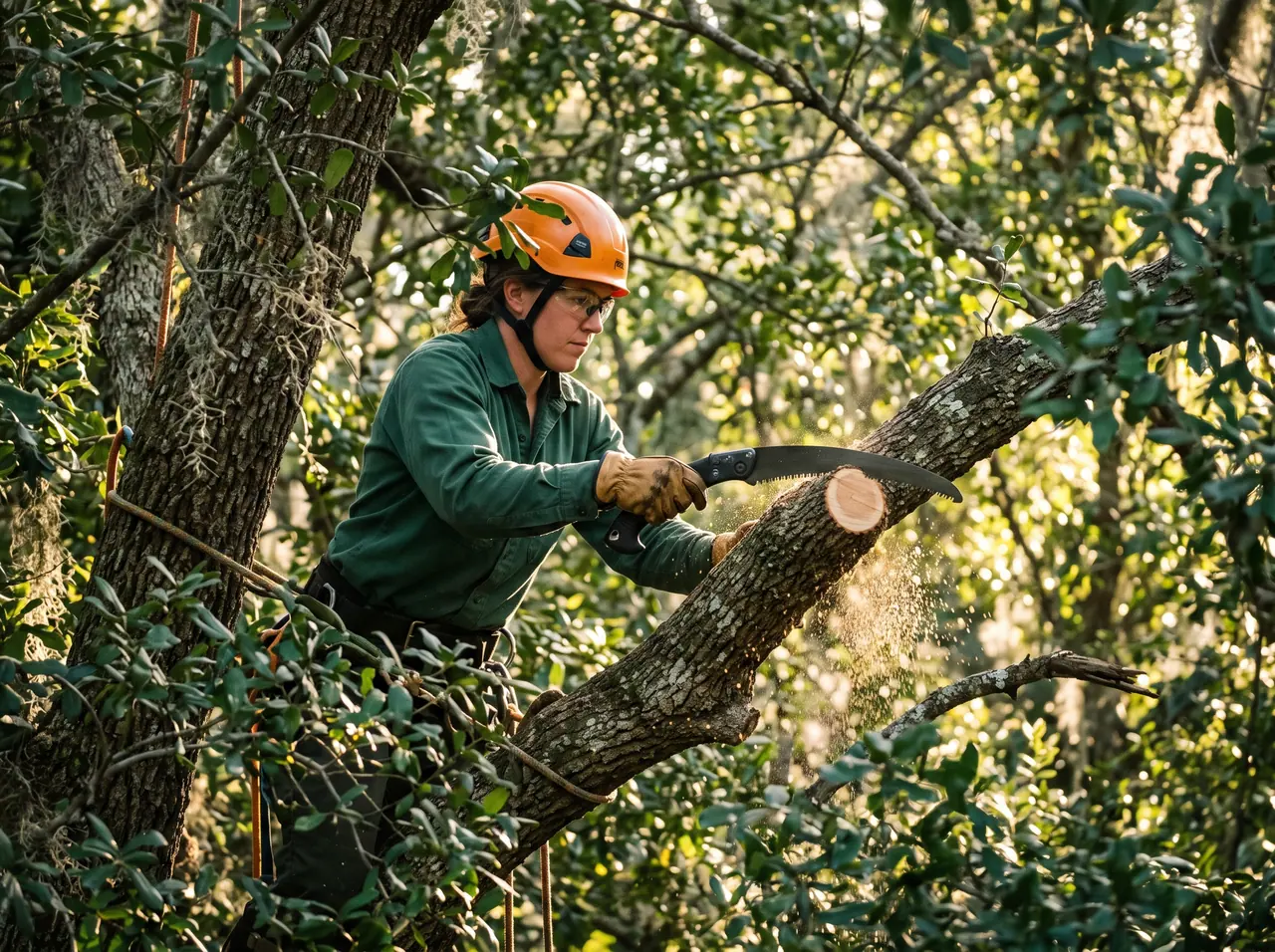
Most trees in Central Texas are not pruned too little. They are pruned badly. A crew with a bucket truck and a chainsaw can make a tree smaller in an afternoon, but cutting into the wrong place leaves wounds a live oak will spend a decade trying to close, and topping a tree triggers a flush of weak, fast-growing shoots that are far more likely to fail in the next storm than the limb that was removed.
Pruning is a series of decisions about which limbs the tree can afford to lose. Our arborists work from the structure outward: remove what is dead, dying, diseased or rubbing, then reduce the limbs carrying the most leverage over your roof, then stop. The goal is a tree that carries its own weight better than it did before we arrived.
Every cut is made at the branch collar so the tree can compartmentalise the wound properly. We do not use climbing spikes on trees we are not removing, because spike wounds are permanent entry points for decay and, in this region, for oak wilt.
What is included
- Deadwood removal
- All dead, hanging and broken limbs over 1 inch removed from the crown, which is where most of the immediate risk to people and property sits.
- Crown cleaning and thinning
- Selective removal of crossing, rubbing and weakly attached limbs to improve air movement and reduce the sail area the crown presents in high wind.
- Structural reduction
- Shortening over-extended limbs back to a suitable lateral branch, reducing leverage without leaving stubs or triggering water sprouts.
- Clearance pruning
- Roof, gutter, driveway, walkway and utility clearance cut to the distances your insurer and the City of Austin actually ask for.
- Immediate wound sealing
- Any oak pruned between February and June gets pruning paint applied within minutes of the cut, which is the single most effective way to avoid oak wilt transmission.
- Complete cleanup
- Brush chipped and hauled, debris blown off hardscapes, and the site left cleaner than we found it. Chips can be left as mulch on request at no charge.
How we approach it
- 1
Walk the property
An arborist inspects each tree from the ground and identifies targets, defects and clearance issues before quoting anything.
- 2
Agree the scope in writing
You get a written scope listing each tree and the specific work planned on it. Nothing is agreed verbally, and nothing appears on the invoice that was not in the scope.
- 3
Prune from the canopy
Climbers work on rope and saddle so limbs are reached from above and cut precisely, rather than reaching in blind from a bucket.
- 4
Clean and walk it back
The site is cleared, then the crew leader walks the finished work with you before the truck leaves.
Before we quote
What shapes the work
Nobody can scope this accurately over the phone, and any company that tries is guessing. These are the five things an arborist is actually assessing when they walk your property.
- Size and species
- A 60-foot live oak takes far longer to work than a 20-foot crepe myrtle. Species also matters: cedar elms and pecans drop far more deadwood than oaks.
- Access
- A front-yard tree we can park beside is far quicker to work than a back-yard tree where every limb has to be carried out through a gate by hand.
- Proximity to targets
- Limbs over a roof, a pool or a power line have to be rigged down piece by piece rather than dropped, which takes considerably longer.
- Time since last pruning
- A tree pruned three years ago is a maintenance visit. A tree never pruned in twenty years is a restoration project, and sometimes needs two visits a year apart.
- Debris volume
- Hauling and disposal is a real part of the day. Leaving the chips on site as mulch takes it out of the job on most properties.
Questions
Tree Trimming & Pruning questions
When is the best time to trim oak trees in Austin?
Prune oaks between July and January in Central Texas. Avoid February through June entirely if possible, because that is when the sap-feeding beetles that spread oak wilt are most active and most attracted to fresh wounds. If an oak must be pruned during that window for safety reasons, every cut needs pruning paint applied immediately.
How much of a tree can safely be removed at once?
No more than 25% of a live crown in a single growing season, and considerably less on a mature or stressed tree. Removing more than that starves the tree of the foliage it needs to produce energy, which usually triggers a flush of weak water sprouts and leaves the tree in worse condition than before.
Do you top trees?
No. Topping is cutting main limbs back to stubs with no regard for branch structure, and it is rejected by every arboricultural standard including ANSI A300. It creates decay pockets, forces weakly attached regrowth and shortens the life of the tree. When a tree genuinely needs to be smaller, we use crown reduction, which cuts back to a suitable lateral branch instead.
How often should mature trees be pruned?
Most established live oaks in Austin need attention every three to five years. Faster-growing species like cedar elm, hackberry and Arizona ash usually want a visit every two to three years. Young trees benefit from light structural pruning every couple of years, which is by far the easiest way to avoid serious structural problems later.
Will pruning make my tree grow back thicker?
Not in the way people expect. Proper thinning does not increase density, it reduces it so wind can pass through. Heavy topping does trigger dense regrowth, but that regrowth is weakly attached and is exactly what you do not want on a limb hanging over your house.
Often needed alongside
Tree Health & Oak Wilt Management
Diagnosis and treatment for oak wilt, decline and pests, from the people who see it every week.
Read moreCabling & Bracing
Hardware support that keeps a structurally weak but otherwise healthy tree standing.
Read moreTree Removal
Technical, piece-by-piece removal of trees that cannot be saved, including work over roofs and pools.
Read moreTree Trimming & Pruning across Greater Austin
We carry out this work in every city we serve, with no travel surcharge. Local soil, species and permit rules differ, so each city page covers what actually changes.
Ready to book tree trimming & pruning?
A free on-site visit from an arborist, the whole scope agreed in writing before we start, and complete cleanup when we finish.
- Free on-site visit, usually within 2 to 3 days
- Every tree named in writing before we start
- No obligation and no pressure to book