Either way you end up talking to the same crew. This just decides what we put in front of you first — and the storm line is (512) 555-0142 whichever you pick.
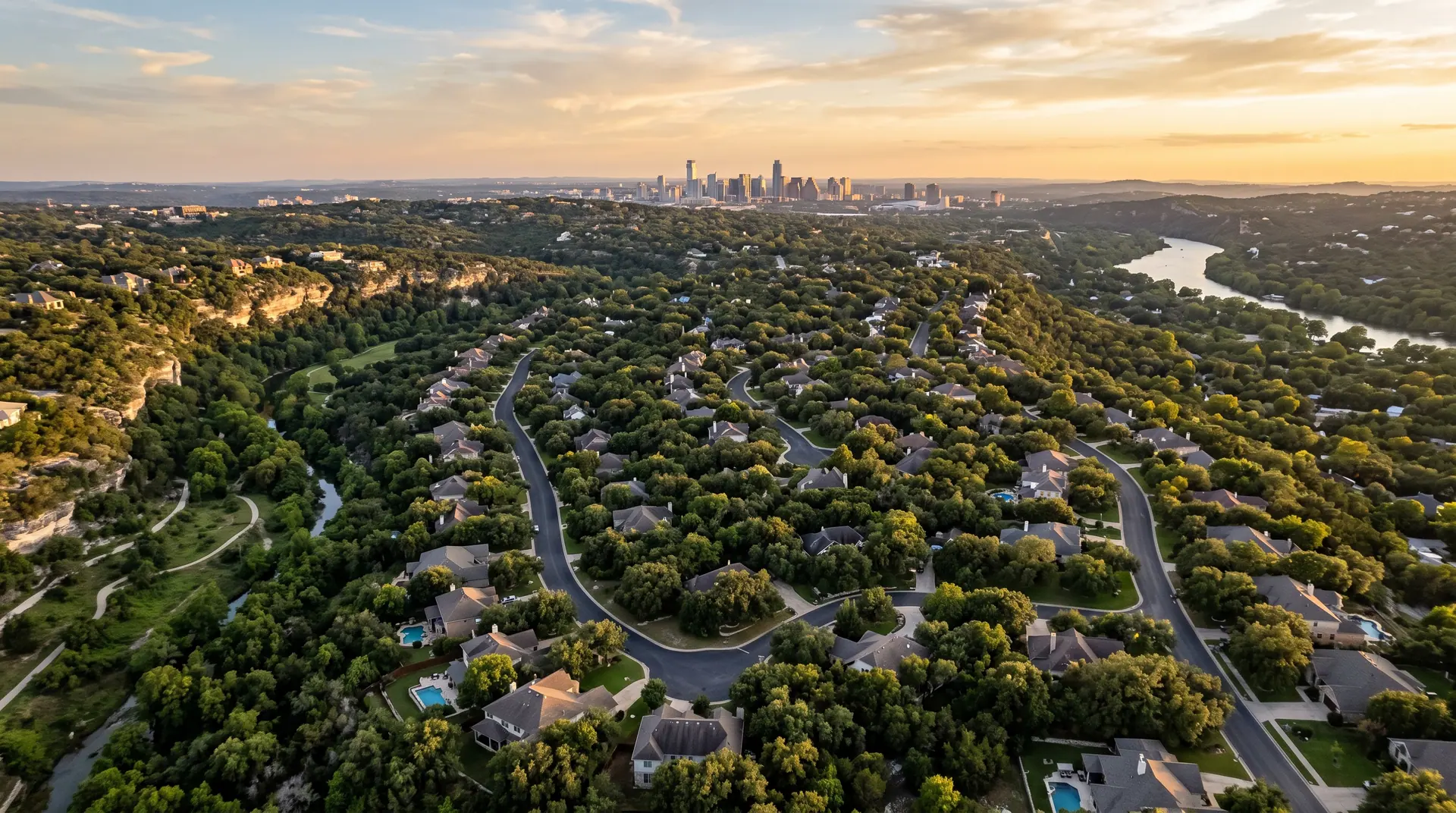
Leander has grown faster than almost anywhere else in Texas, and its tree work reflects two very different worlds sitting side by side. There are brand new subdivisions where every tree was planted within the last decade, and there are multi-acre lots still carrying the native cedar and oak cover that was there long before the development arrived.
On the acreage side the work is selective clearing: taking out the dense Ashe juniper that shades out everything else, keeping the live oaks and Texas red oaks worth having, and creating defensible space around the house. On the subdivision side it is almost entirely structural pruning of young trees, which is the most effective tree work anyone will ever have done.
Leander sits at the western edge of oak wilt pressure moving up from the Austin side. It is worth taking the February to June pruning restriction seriously here even though the disease is less established than it is in West Austin.
What is different about Leander trees
Two very different property types
New subdivision lots need structural pruning of young trees. Acreage lots need selective cedar clearing and fuel reduction. The equipment and the approach have almost nothing in common.
Heavy Ashe juniper cover
Undeveloped and semi-developed Leander land carries dense cedar that consumes water and suppresses hardwood regeneration. Selective mulching opens it back up.
Establishment watering matters
Newly planted subdivision trees on thin Leander soil fail more often from inadequate first-summer watering than from anything else. Deep infrequent soaking beats frequent sprinkler cycles.
Western oak wilt edge
Oak wilt pressure extends into this area from the southeast. Observe the February to June no-pruning window on all oaks regardless of how healthy they look.
Trees we work on in Leander
Ashe juniper
Live oak
Texas red oak
Cedar elm
Mesquite
Neighbourhoods we cover
If you are near Devine Lake Park, we are already working your street most weeks. This list is not exhaustive, so call even if you do not see your subdivision.
Density, terrain and selectivity, in that order. Scattered cedar on level ground moves quickly. A continuous thicket on a steep limestone slope with dozens of keeper trees flagged is slow, careful work. Larger parcels go faster per acre because mobilising the mulcher takes the same effort either way. We walk the parcel with you, flag what stays, and put the whole scope in writing before anything starts.
My new subdivision trees look fine. Do they need pruning?
Almost certainly yes, and this is the most under-appreciated tree work there is. Nursery trees frequently develop two competing leaders and low scaffold limbs that will be serious problems at maturity. Correcting that now takes minutes with a hand saw. Correcting it in twenty years means a crane, a permit and a full crew for a day.
Is oak wilt in Leander?
It is present in the wider area and pressure has extended northwest over time, though it is less established than in West Austin. Treat the February to June no-pruning window as a firm rule regardless, and have any oak showing veinal yellowing or unexplained crown thinning inspected promptly rather than waiting a season.
Work log
Recent work near Leander
These are illustrative of the kind of work and the kind of decision, written up as a crew note. This is a demonstration site: it publishes no reviews, no ratings and no customer names, because it has no customers.
Tree RemovalTravis Heights, AustinJune
Dead pecan standing six feet from a bedroom wall.
No room to fell and no crane access down the side return, so the tree came down in rigged sections lowered on a friction device. The climber walked the homeowner through the rigging plan from the ground before going up, which is standard: anyone whose house is under the drop zone is entitled to understand it.
Close quarters is a rigging problem, not a felling problem.
Tree Trimming & PruningForest Creek, Round RockMay
Homeowner had two quotes to top the tree.
Topping was declined and the reason explained: the flush of weak regrowth it triggers is far more likely to fail than the limb being removed, and the decay pockets left behind never close. The tree was reduced to suitable lateral branches instead, taking roughly 15% of the live crown.
A company that offers to top your tree is telling you something.
Oak Wilt ManagementNorthwest Hills, AustinMay
Three live oaks thinning from the top down.
Pattern and veinal necrosis matched oak wilt. A trench was cut to sever the root grafts running toward the healthy stems, and the two unaffected trees were injected. The infected tree was removed outside beetle season and the wood was not kept on site.
Roughly 90% of local spread is underground. Trenching is the treatment.
Both themes are drawn rather than inverted. Light is the canopy at noon, dark is the understory at dusk, and the drifting light in the hero is tuned separately for each.
Mode
The same switch that sits in the header. Emergency mode overrides the colour scheme on purpose — see the note under Palette.
Colour scheme
Four schemes, each measured for text contrast in both light and dark before it was offered here. A scheme that could not pass in both is not in this list.
Emergency mode is frozen against this control. Whatever scheme you pick, a limb on the roof is always signal amber — a warning colour that moves with a brand preference is not a warning colour.
Text size
Switches
Reduce motion starts switched on if your device already asks for it. These are real controls, not a badge: this site claims no formal accessibility conformance, because it has not been audited against one. What it has been is measured — seethe accessibility statement.
What this site keeps
us-themelight, dark or system
us-palettewhich colour scheme you chose
us-modeplanning or emergency
us-a11yyour accessibility switches
us-storagethis decision, so we stop asking
Five keys in this browser's localStorage, and nothing else. No analytics, no advertising, no third-party scripts, no cookies at all. They are functional preferences rather than tracking, but they are still yours to refuse.
Internal machinery. Reachable only at ?studio=1 and never shown to a visitor.
Identity
Colour
Type pairing
This site keeps five preference keys in your browser — theme, colour scheme, mode and your accessibility switches. No cookies, no analytics, no third parties.