Greater Austin
Arborist Consulting & Risk Assessment
Written, defensible assessments for permits, construction, disputes and insurance.
- Standard
- Written and defensible
- Booking
- 5 to 8 days
- Emergencies same day
- Estimate
- Free on site
- No obligation
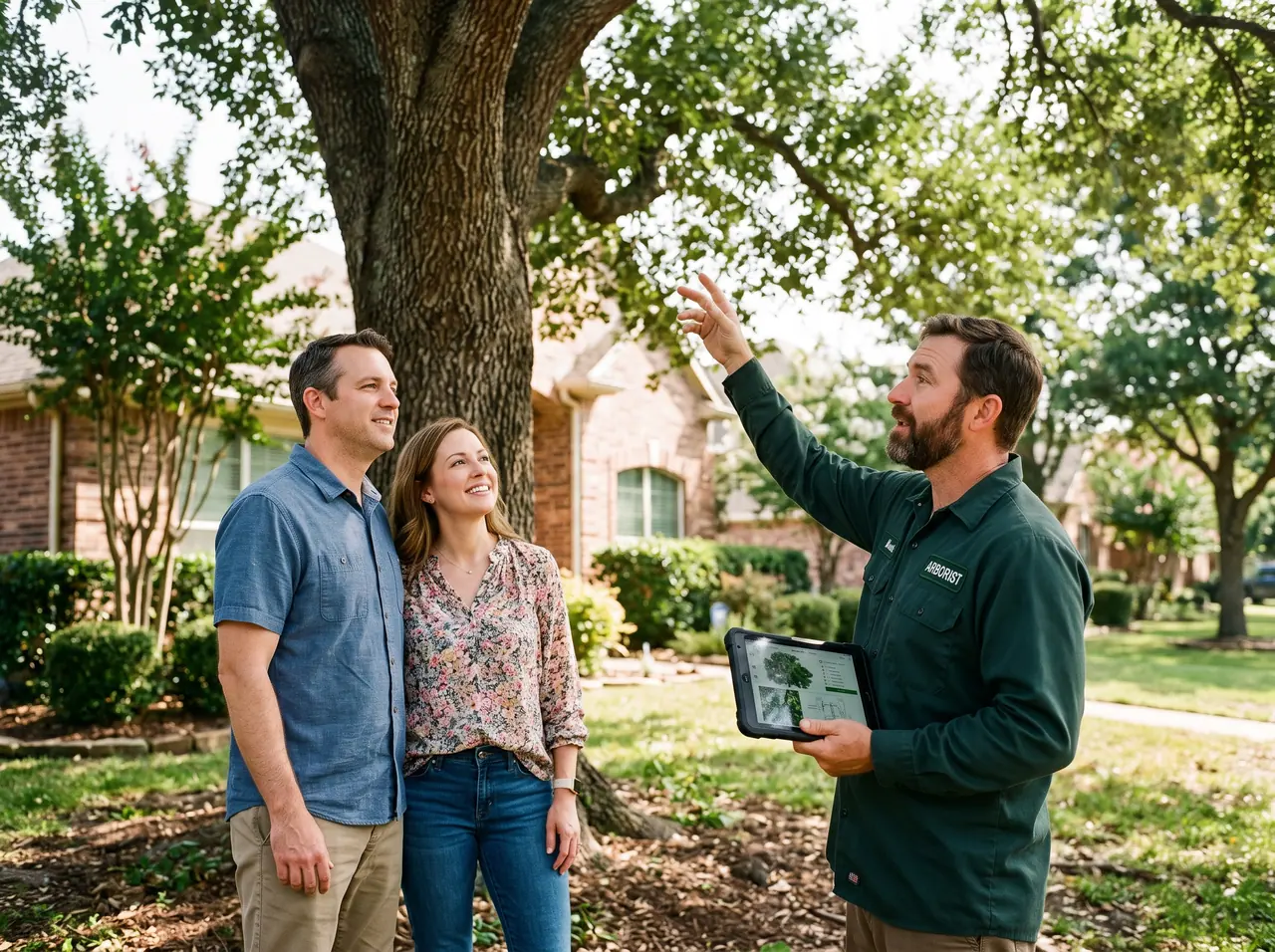
Sometimes the thing you actually need is not a crew, it is an answer in writing. Whether a tree is genuinely hazardous. Whether the builder next door has damaged your oak. What your permit application needs to include. Whether the tree that fell was already failing before the storm.
We provide these assessments independently. When the report is the product, our recommendation is not tied to selling you removal work, and that separation is precisely what makes the document worth anything to a permitting office, an insurer or a court.
The methodology is the ISA Tree Risk Assessment Qualification framework, the industry standard, which evaluates three things: how likely the tree is to fail, how likely it is to hit something if it does, and how bad that would be. Those combine into a defined risk rating with mitigation options, rather than an opinion.
What is included
- Level 2 basic assessment
- A full 360-degree ground inspection covering root flare, trunk, branch unions and crown, which is the standard for most residential questions.
- Advanced diagnostics
- Where decay is suspected, resistance drilling and sounding to establish how much sound wood actually remains in the trunk.
- Written report
- A documented report with photographs, findings, a defined risk rating and prioritised mitigation options, formatted for permitting and claims.
- Construction protection plans
- Critical root zone mapping, protective fencing specification and mitigation measures for trees on active build sites.
- Appraisal and damage valuation
- Trunk Formula Technique valuation for insurance claims, neighbour disputes and construction damage.
- Expert testimony
- Deposition and testimony support where a tree matter reaches litigation.
How we approach it
- 1
Define the question
We establish exactly what the report has to answer and who will read it, because a permit officer and an insurance adjuster need different documents.
- 2
Inspect on site
A systematic ground inspection of every tree in scope, with measurements, photographs and advanced diagnostics where decay is suspected.
- 3
Analyse and rate
Findings assessed against the industry tree risk framework to produce a defined risk rating for each tree, with realistic mitigation options.
- 4
Deliver and support
A written report delivered within five business days, with follow-up support if a reviewer or adjuster raises questions.
Before we quote
What shapes the work
Nobody can scope this accurately over the phone, and any company that tries is guessing. These are the five things an arborist is actually assessing when they walk your property.
- Number of trees
- A single-tree opinion is straightforward. A campus inventory of two hundred trees is a different scale of work entirely.
- Depth of assessment
- A visual Level 2 inspection is a straightforward site visit. Advanced diagnostics involving resistance drilling and decay mapping is a much longer piece of work.
- Report purpose
- A homeowner letter is simple. A report built to survive cross-examination in litigation requires far more documentation.
- Turnaround
- Standard delivery is five business days. Expedited 48-hour turnaround is available when a permit or closing deadline is looming.
- Site complexity
- Steep terrain, restricted access and trees requiring aerial inspection all add time on site.
Questions
Arborist Consulting & Risk Assessment questions
How is tree risk actually assessed?
The recognised industry framework is the International Society of Arboriculture Tree Risk Assessment Qualification, usually shortened to TRAQ. It scores three separate factors: the likelihood the tree or part fails, the likelihood it impacts a target if it does, and the consequences of that impact. Those combine into a defined risk rating, which is far more defensible than a subjective opinion.
Do I need an arborist report for my Austin tree permit?
Frequently, yes. The City of Austin generally requires a written arborist assessment when you apply to remove a protected tree of 19 inches diameter or more, and always for Heritage trees at 24 inches and above. Reports are also commonly required for development permits where construction will occur inside a tree critical root zone.
What do I actually get in a written assessment?
A documented report with photographs, measurements, findings, a defined risk rating for each tree in scope, and prioritised mitigation options. It is formatted for whoever has to read it, because a City permit reviewer, an insurance adjuster and an attorney all need different things from the same inspection. Scope ranges from a single-tree opinion up to a full construction tree protection plan with ongoing site monitoring, and we agree that scope with you before the site visit.
Will you recommend removal just to sell the work?
No, and the consulting side of the business exists partly to make that credible. A large share of our assessments conclude that the tree is retainable with pruning, cabling or a change in site management. If we do recommend removal we document precisely why, and you are entirely free to take that report to any contractor you choose.
How fast can I get a report?
Standard turnaround is five business days from the site visit, and expedited 48-hour delivery is available where a permit or closing deadline requires it. Site visits can usually be scheduled within a week, and faster outside storm season.
Often needed alongside
Tree Health & Oak Wilt Management
Diagnosis and treatment for oak wilt, decline and pests, from the people who see it every week.
Read moreCabling & Bracing
Hardware support that keeps a structurally weak but otherwise healthy tree standing.
Read moreTree Removal
Technical, piece-by-piece removal of trees that cannot be saved, including work over roofs and pools.
Read moreArborist Consulting & Risk Assessment across Greater Austin
We carry out this work in every city we serve, with no travel surcharge. Local soil, species and permit rules differ, so each city page covers what actually changes.
Ready to book arborist consulting & risk assessment?
A free on-site visit from an arborist, the whole scope agreed in writing before we start, and complete cleanup when we finish.
- Free on-site visit, usually within 2 to 3 days
- Every tree named in writing before we start
- No obligation and no pressure to book