Greater Austin
Land & Lot Clearing
Selective clearing that takes out the cedar and leaves the oaks worth keeping.
- Standard
- Selective mulching
- Booking
- 5 to 8 days
- Emergencies same day
- Estimate
- Free on site
- No obligation
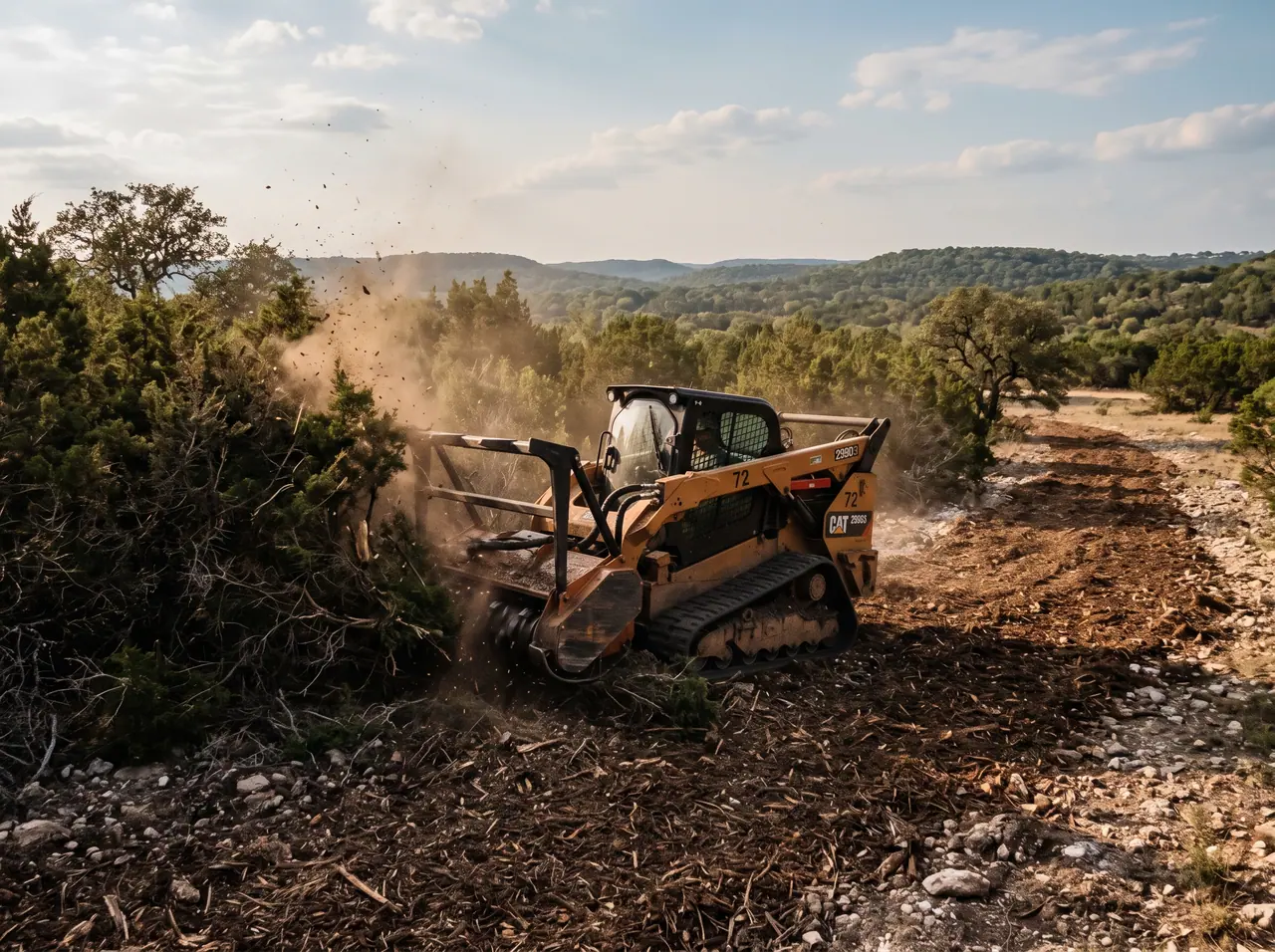
Most Hill Country land does not need clearing so much as editing. Ashe juniper, which everyone here calls cedar, grows into dense thickets that shade out grass, crowd young hardwoods and consume a remarkable amount of water. Underneath that thicket there are usually live oaks and cedar elms worth keeping, and the difference between good clearing and bad clearing is whether anyone bothered to look for them.
We clear selectively. Before machinery starts we walk the parcel with you and mark what stays: the heritage oaks, the specimen trees near the build site, the screen along the property line. Everything else is mulched in place, which leaves a layer of chip on the ground that holds soil against Texas downpours instead of leaving bare dirt to wash into the creek.
For anyone west of Mopac, this is also fire work. Reducing continuous cedar cover and creating defensible space around structures is one of the few genuinely effective things a landowner can do before wildfire season.
What is included
- Walk and mark
- The parcel walked together before machinery arrives, with keeper trees flagged and clearing boundaries agreed on the ground.
- Forestry mulching
- A tracked mulcher processes standing cedar and brush in place, leaving an even chip layer rather than burn piles or bare soil.
- Selective hardwood retention
- Live oaks, cedar elms and other natives worth keeping are preserved and given room, which raises the value of the land considerably.
- Defensible space
- Fuel reduction zones cut around structures and access routes to recognised wildfire spacing guidance.
- Fence lines and access
- Fence lines, trails, culverts and equipment access cleared to the widths you actually need.
- Build pad preparation
- Clearing and grubbing for house pads, barns and driveways, coordinated with your builder and surveyor.
How we approach it
- 1
Survey the parcel
We walk the land, discuss what it is for, identify keeper trees, and check property lines, easements and drainage.
- 2
Mark and agree
Keeper trees flagged, clearing limits marked on the ground and the whole scope agreed in writing before any machinery mobilises.
- 3
Mulch and clear
Tracked equipment works section by section, mulching cedar and brush in place while working around every flagged tree.
- 4
Finish and inspect
Edges cleaned up, chip spread evenly, access ways finished, and the whole parcel walked with you before demobilisation.
Before we quote
What shapes the work
Nobody can scope this accurately over the phone, and any company that tries is guessing. These are the five things an arborist is actually assessing when they walk your property.
- Density of growth
- Scattered cedar on grassland moves quickly. A continuous thicket you cannot walk through can take three times as long per acre.
- Stem size
- Brush and small cedar mulch fast. Mature juniper and hardwood over 10 inches slows the machine considerably.
- Terrain
- Steep slopes, exposed limestone shelf and creek crossings all reduce how many acres a machine can cover in a day.
- Selectivity
- Clear-cutting is fastest. Careful selective work around dozens of flagged keeper trees takes considerably longer and is almost always worth it.
- Total acreage
- Larger parcels are far more efficient per acre, because mobilising the equipment takes the same effort whether you clear one acre or fifteen.
Questions
Land & Lot Clearing questions
What decides how long a clearing job takes?
Density first: scattered cedar on level grassland moves quickly, while a continuous thicket you cannot walk through can take three times as long per acre. Then stem size, terrain and selectivity. Light cedar on flat ground is the easy end. Dense mixed timber on a steep limestone slope with dozens of flagged keeper trees is the hard end. Larger parcels go faster per acre, because mobilising the equipment takes the same effort either way.
What is forestry mulching and why use it?
A tracked machine with a rotating drum grinds standing vegetation into chip where it stands, in a single pass. There is no burning, no hauling and no piles to dispose of. The chip layer left behind holds soil against heavy rain, suppresses regrowth for a season or two and breaks down into organic matter, which matters on thin Hill Country soil.
Do I need a permit to clear land in Travis County?
It depends on location and scale. Inside Austin city limits, tree protection ordinances apply to trees above certain diameters even on undeveloped land. Outside city limits, requirements are lighter but development, floodplain and Edwards Aquifer recharge zone rules can still apply. We identify what applies to your parcel during the survey.
Will you leave my oak trees?
Yes, and this is the core of how we work. We walk the parcel with you before anything starts and flag every tree that stays. Operators work around flagged trees and we take care to avoid compacting soil inside their root zones, which is the damage people usually only notice two years later.
How long does clearing take?
A single acre of light cedar can be done in a day. Dense growth on rough terrain runs closer to two or three days per acre. We give you an acreage-per-day estimate after walking the site, and mobilisation is usually within one to two weeks outside storm season.
Often needed alongside
Stump Grinding & Removal
Grinding well below grade so you can replant, re-turf or build over the spot without a callback.
Read moreCommercial & HOA Tree Care
Scheduled contract maintenance, tree inventories and the paperwork your board and insurer want.
Read moreTree Removal
Technical, piece-by-piece removal of trees that cannot be saved, including work over roofs and pools.
Read moreLand & Lot Clearing across Greater Austin
We carry out this work in every city we serve, with no travel surcharge. Local soil, species and permit rules differ, so each city page covers what actually changes.
Ready to book land & lot clearing?
A free on-site visit from an arborist, the whole scope agreed in writing before we start, and complete cleanup when we finish.
- Free on-site visit, usually within 2 to 3 days
- Every tree named in writing before we start
- No obligation and no pressure to book