Greater Austin
Crane-Assisted Tree Removal
For trees too large, too dead or too close to the house to dismantle safely on rope alone.
- Standard
- Zero-impact lifts
- Booking
- 5 to 8 days
- Emergencies same day
- Estimate
- Free on site
- No obligation
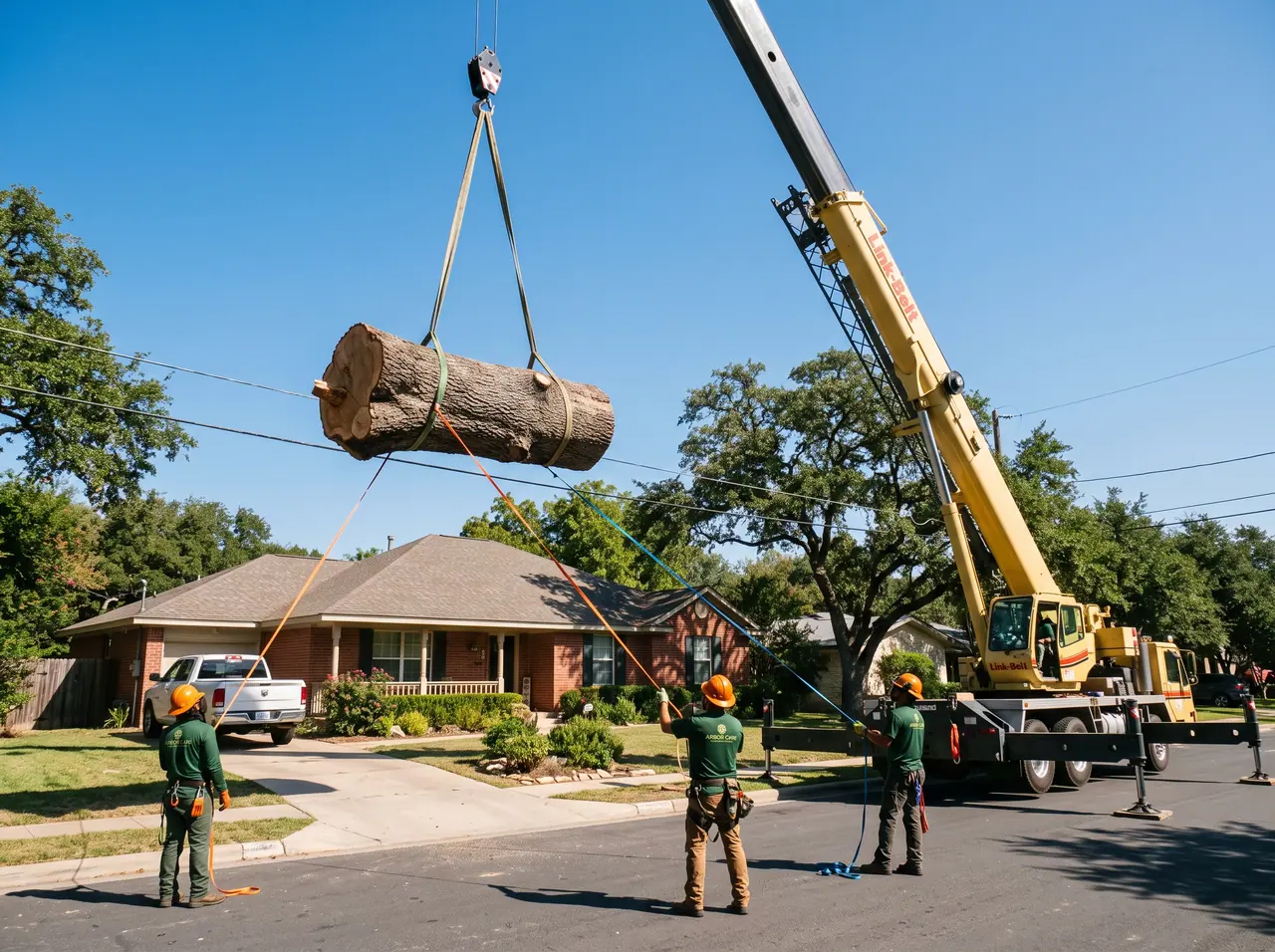
There is a point where rope and saddle stop being the right answer. A trunk so decayed that a climber cannot trust it. A 90-foot pecan leaning over a pool with no drop zone at all. A tree in a back yard with no gate wide enough for anything to come out through. In those situations a crane is not a luxury, it is the method that makes the job safe.
The advantage is not just capacity, it is control. Each section is picked before it is cut, so its weight is already carried by the crane at the moment it separates. Nothing swings, nothing shock-loads a rigging point, and nothing lands on your property. Pieces travel up and out over the roofline and are set down on the street.
It is also faster. A large removal that would take a rope crew two full days often takes six hours with a crane, and because the crew spends far less time working under suspended loads, the whole operation is safer for everyone including your neighbours.
What is included
- Lift plan and engineering
- Pick points, section weights and crane positioning worked out before the day so nothing is estimated with a load in the air.
- Dedicated operator and rigger
- A crane operator working with a climber setting chokers, communicating on a dedicated channel throughout.
- Street and access management
- Traffic control, cones and any temporary right-of-way permit arranged where the crane must set up in the roadway.
- Zero-impact removal
- Sections lifted clear and lowered to a landing zone on the street, so no weight ever touches your roof, pool, deck or beds.
- Rapid processing
- A ground crew chipping and loading continuously at the landing zone while the crane keeps working.
- Full site restoration
- Landing zone swept, mats lifted, lawn repaired where outriggers sat, and the street left clean.
How we approach it
- 1
Survey and plan
We measure the tree, calculate section weights, confirm crane reach from the only available set-up point and check overhead clearances.
- 2
Set up and secure
Crane positioned on outrigger mats, work zone closed off, traffic control placed and the lift plan briefed to the whole crew.
- 3
Pick and cut
The climber sets a choker on each section, the crane takes the weight, the cut is made and the piece flies out over the roofline.
- 4
Process and restore
Sections processed at the landing zone, stump ground if requested, and the site and street fully restored.
Before we quote
What shapes the work
Nobody can scope this accurately over the phone, and any company that tries is guessing. These are the five things an arborist is actually assessing when they walk your property.
- Crane size required
- Reach and capacity decide which machine comes out. Longer reach from a distant set-up point needs a substantially bigger crane.
- Set-up position
- A crane that can sit on the street beside the tree is straightforward. One that has to reach over a house from two lots away is not.
- Number of picks
- Each cut and lift cycle takes time. A tree that can come out in eight picks is a much shorter day than one needing twenty.
- Overhead obstructions
- Power lines, communications cable and neighbouring canopy all restrict the swing path and slow every cycle.
- Permits and traffic control
- Closing a lane in parts of Austin requires a permit and a traffic control plan, which has to be arranged well in advance.
Questions
Crane-Assisted Tree Removal questions
When is a crane necessary instead of climbing?
When the trunk is too decayed to bear a climber safely, when the tree is very large and directly over a structure, when there is no drop zone beneath the canopy, or when back-yard access is too tight to carry material out. On very large trees a crane is often simply the better option, because it can complete in one day what would take a rope crew two or three.
Does the crane need to be on my property?
Usually not. Most residential removals are done with the crane set up on the street, reaching over the house. It needs a stable, level footprint for outriggers and clear overhead space to swing. We check all of this during the survey and tell you exactly where it will sit and which vehicles need to move.
Will the crane damage my driveway or lawn?
Outriggers concentrate very high point loads, so we always place engineered mats to spread the weight. On a standard residential driveway that is usually enough. Where a set-up point is unavoidably on turf, some compression is expected and we repair it as part of the job. If your driveway has known structural issues, tell us during the survey.
How does a crane removal compare with a rope dismantle?
A crane brings in a machine, an operator and a rigging crew, so it is a bigger operation to set up. What you get back is control and time: nothing shock-loads a rigging point, nothing touches your roof or pool, and a job that would take a rope crew two or three days often finishes in one. On very large or badly decayed trees it is frequently the only safe method. Where both approaches are genuinely viable, we will scope both and explain the trade-off.
How long does a crane removal take?
Most residential crane removals are complete within a single day, commonly four to eight hours on site including set-up and cleanup. The crane itself is often only needed for two to three hours of that. Very large multi-stem trees occasionally need a second day.
Often needed alongside
Tree Removal
Technical, piece-by-piece removal of trees that cannot be saved, including work over roofs and pools.
Read more24/7 Emergency Storm Damage
A real crew on the phone at 3am, not an answering service. Trees off houses, driveways cleared.
Read moreStump Grinding & Removal
Grinding well below grade so you can replant, re-turf or build over the spot without a callback.
Read moreCrane-Assisted Tree Removal across Greater Austin
We carry out this work in every city we serve, with no travel surcharge. Local soil, species and permit rules differ, so each city page covers what actually changes.
Ready to book crane-assisted tree removal?
A free on-site visit from an arborist, the whole scope agreed in writing before we start, and complete cleanup when we finish.
- Free on-site visit, usually within 2 to 3 days
- Every tree named in writing before we start
- No obligation and no pressure to book