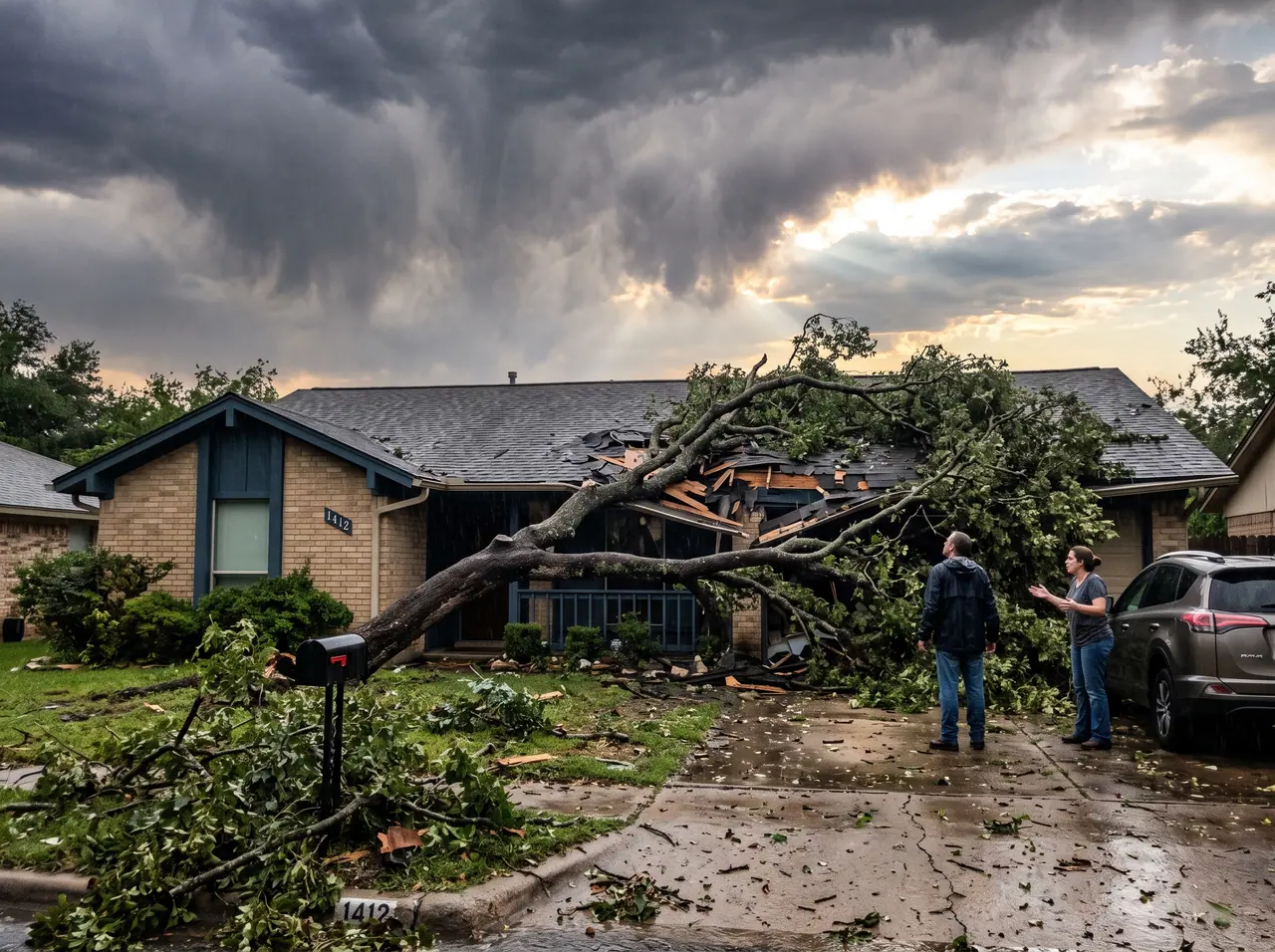
Why Central Texas trees fail
Storm failures here are rarely random. Four patterns account for most of what we cut off roofs.
Co-dominant stems with included bark. A great many live oaks split into two or more trunks of similar size low on the tree. Where those stems meet, bark often becomes trapped in the union instead of the wood knitting together. The union looks solid for thirty years and then fails in one gust, usually taking half the tree.
Deadwood that was already dead. A dead limb has no flexibility. It does not bend and shed load in wind, it snaps. Most of what lands on cars during a storm was dead long before the storm arrived, and could have been removed on a scheduled visit for a fraction of the cost.
Saturated soil after drought. This is the sequence that catches people out. Drought damages fine roots and shrinks clay soil. Heavy rain then saturates the ground, reducing its grip on an already compromised root plate, and the first strong wind pushes the whole tree over. The tree that fails is frequently the one that looked fine all summer.
Over-extended limbs. A long horizontal limb is a lever. The further it reaches, the more force its own weight and the wind apply at the attachment point.
What genuinely reduces risk
Crown thinning
Selective removal of interior branches lets wind pass through the canopy rather than pushing against it. Less sail area means less force at every attachment point. This is the single most effective preventative measure for a mature tree near a structure.
Note the word selective. Thinning is not the same as removing everything from the interior, which is a real practice called lion-tailing and makes failure more likely by concentrating all the weight at the limb tips.
Deadwood removal
Straightforward, and disproportionately valuable. Everything dead over about an inch comes out, because that is what is going to fall first.
Cabling weak unions
Where a tree has a co-dominant union you want to keep, a flexible steel or synthetic cable installed high in the canopy limits how far the stems can move apart under load. It does not immobilise the tree, and should not, because trees need movement to build reaction wood. At $450 to $1,600 it frequently saves a tree that has been quoted for removal at three times that.
Structural reduction
Shortening the limbs with the most leverage over your roof, cut back to a suitable lateral branch. Less mass, shorter lever arm, less force at the union.
Root zone care
Do not park on it, do not trench through it, do not raise the grade over it, and mulch it rather than growing turf against the trunk. Most root damage shows up in the crown two or three years later, by which point nobody connects the two.
What does not help
- Topping. It makes trees more dangerous, not less. The regrowth is weakly attached and the wounds invite decay.
- Removing every tree near the house. Trees also shelter each other. A tree suddenly left exposed after its neighbours are removed is at higher risk than it was.
- Waiting for a visible problem. By the time a crack is visible from the ground, the failure is well advanced.
The first hour after a tree comes down
- Get people clear. Out of affected rooms, away from the tree, away from anything hanging.
- Assume every line is live. If any conductor is down or touching the tree, stay far back and call Austin Energy. No tree crew can work near an energised line.
- Photograph before anything moves. Wide shots and close shots. Your insurer will want to see the position of the tree relative to the structure before cleanup begins.
- Call a tree service, not a handyman with a chainsaw. A limb resting on a roof holds stored energy. Cut it in the wrong order and the rest of it drops through the ceiling rather than lifting away.
- Do not climb on it. Storm-damaged trees shift.
What to expect from an emergency crew
A good response makes the situation safe first and cleans up second. That means removing the immediate hazard, tarping what needs tarping, and clearing your driveway so you, your roofer and your adjuster can all get in. The full cleanup is normally scheduled afterwards at standard rates rather than emergency ones.
Expect a higher mobilisation rate for overnight and holiday call-outs, and expect an honest company to tell you when a hazard is stable enough to wait until first light.